 0
0
 0
0
Most travelers meet Tanzania from the seat of a safari vehicle or the window of a small plane, hopping from park to park with the efficiency that a short holiday demands. But there is an older, slower way to cross this country, one that most visitors never consider, and it may be the most rewarding of all. The TAZARA railway carries you from the humid coast at Dar es Salaam deep into the interior and onward across the border into Zambia, a journey of roughly eighteen hundred and sixty kilometers that unfolds not in hours but in days. To board this train is to trade speed for something rarer: the chance to watch an entire landscape change slowly outside your window, one valley at a time.
The trip begins in Dar es Salaam, where the great terminus stands as a monument to another era. The station itself carries the weight of history, built as a feat of engineering that stitched two countries together across some of the most difficult terrain in East Africa. On the platform there is none of the sterile hurry of an airport. Instead there are families with bundles, traders with sacks, vendors pressing snacks and bottled water through the windows, and the low mechanical patience of a train that knows it has a very long way to go. You settle into your compartment, the whistle sounds, and the carriages begin to pull away from the ocean and toward the vast green unknown of the Tanzanian heartland.
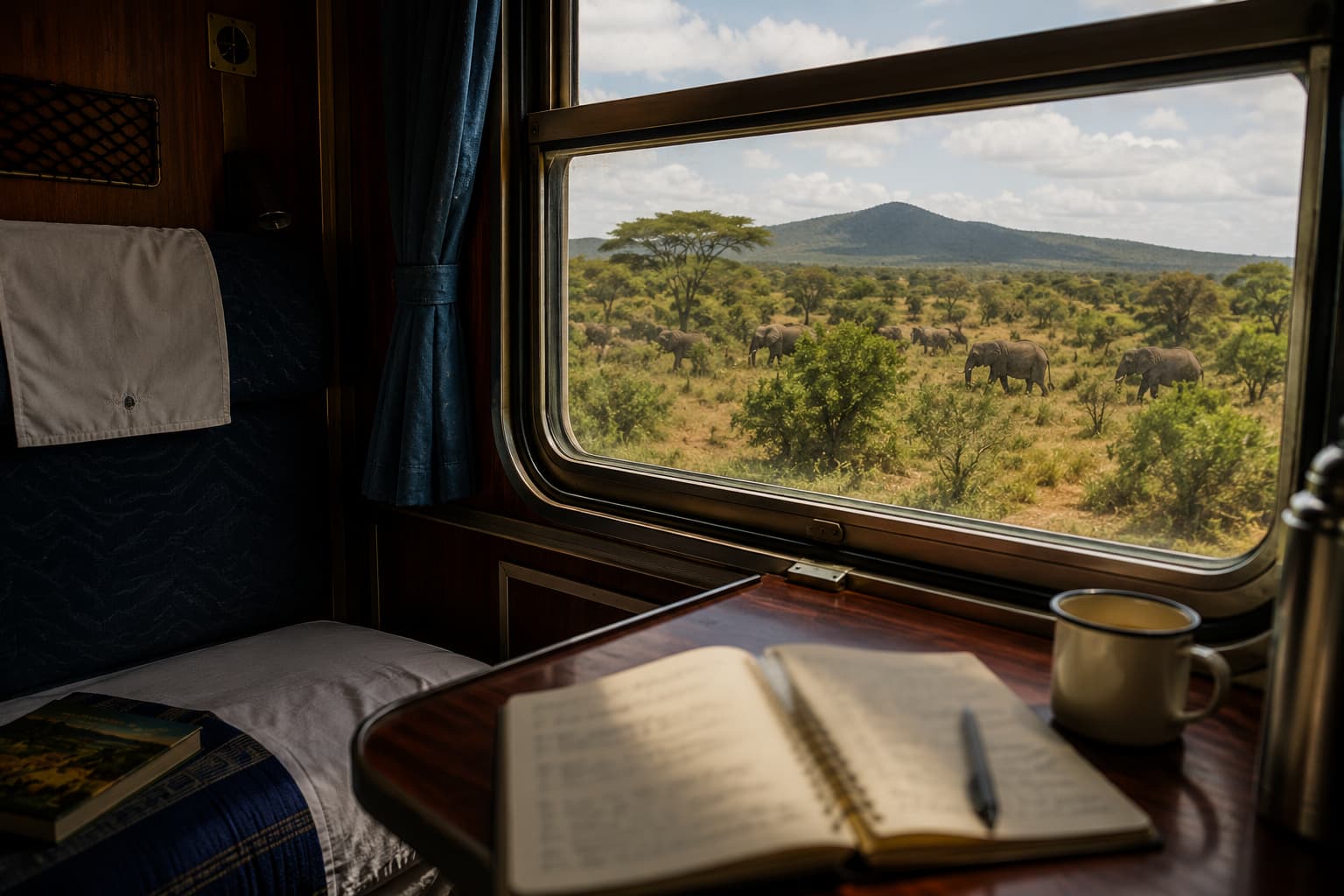
What happens next is the reason to come. Not far out of the city, the line enters the enormous and largely uninhabited wilderness of the Selous, one of the greatest protected areas on the continent, and the train becomes an unlikely safari. There is no guide, no schedule of sightings, no promise of anything at all, and that is precisely what makes it thrilling. Passengers drift to the windows and simply watch. Giraffes appear against the tree line, moving with their strange slow grace. Herds of antelope scatter at the sound of the engine. Elephants stand in the middle distance, unbothered, and zebras flick their tails in the heat. You may see all of this in an afternoon, or you may see almost nothing and then round a bend into a scene that stops your breath. The randomness is the gift. Unlike a game drive engineered to deliver animals, this is wildlife glimpsed on its own terms, indifferent to your presence.
As the hours accumulate the country begins to shift beneath the wheels. The train crosses the Great Ruaha River, its waters wide and brown, and then works its way through a stretch of swamps and shallow valleys where the vegetation grows thick and the air hangs heavy. Small settlements slide past, each one a brief window into a life lived far from any road a tourist would normally travel. Children run alongside the tracks and wave. Women carry water on their heads down paths that lead to nowhere marked on any map. At each remote station the train pauses, and a small economy erupts on the platform, hands reaching up with grilled maize, fruit, hard-boiled eggs, and cold drinks, a rolling market that appears and vanishes in minutes.
Then the land begins to climb, and the character of the journey changes again. The lowland heat gives way to cooler air as the line ascends into rugged mountains, and the engineering that built this railway reveals itself in earnest. The train crosses a remarkable bridge suspended high above the valley of the Mpanga River, a dizzying span that hangs the carriages in open air for a few unforgettable moments. Tunnels swallow the light and release it again. The track curves along steep slopes where the view opens onto folded green ridges rolling toward the horizon. This is the stretch that stays with people, the passage from tropical lowland to highland cool, compressed into a single continuous ribbon of movement that no aircraft could ever let you feel.
The rhythm of life aboard settles into something almost meditative. In first class the compartments are comfortable, with berths that fold down for sleeping, and meals are served in a dining carriage where strangers become companions over plates of rice and stew. There is time here, an abundance of it, the kind modern travel has all but abolished. Time to read, to doze, to talk with a Zambian trader or a Tanzanian student heading home, to simply sit and let the country pour past. Night falls and the darkness outside is total, broken only by the occasional lamp of a distant village, and you sleep to the rocking of the carriage and the steady percussion of the rails.
It should be said plainly that this is not luxury travel in the polished sense, and it rewards patience over precision. Schedules are approximate, delays are part of the experience, and the railway itself has known hard years and uncertain maintenance, even as the country invests in a new generation of rail elsewhere. But to focus on that is to miss the point entirely. The TAZARA is not a way to get somewhere quickly. It is a way to see the parts of Tanzania that lie beyond the reach of any tour, the remote interior that almost no visitor ever witnesses, and to arrive at the far end filled with a nostalgia for a journey that has not even ended yet. For the traveler willing to slow down and surrender to the pace of the rails, it offers something no safari lodge can sell: the whole country, unspooling slowly, mile after unforgettable mile.